

- May 20, 2026
A question comes up regularly in the design and investment decisions of large-scale real estate projects: Is LEED still a meaningful performance driver... or is it simply an additional cost with no direct impact on the real value of assets?
This question is legitimate in a context where pressure on construction costs and timelines is intensifying. But it is often based on an incomplete reading: one focused on initial cost rather than overall performance across the building’s lifecycle.
A Debate Skewed by a “Initial Cost” Only Perspective
The most common criticism of LEED is straightforward: certification adds costs, complexity, and time.
That is partially true… but incomplete. In a large-scale project, the cost of certification typically represents a marginal fraction of the total development cost. The real issue is therefore not the absolute cost, but the relationship between the investment and the value generated over the building’s lifecycle.
Viewed through this lens, targeted investments in a LEED process will often yield a significant ROI over the life of the asset, particularly through reduced maintenance and operating costs, but also through the reduction of externalities on infrastructure, such as the volume of waste sent to landfill, water treatment costs, the costs and public health impacts associated with poor indoor air quality, and the impacts linked to increased vulnerability to climate change.
In other words, reducing LEED to an isolated budget line item means ignoring its fundamental logic: converting upfront costs into recurring gains.
LEED as a Performance Control Tool, Not an Administrative Constraint
When integrated from the earliest phases of a project, LEED functions as a steering system that directly influences:
- the building’s energy performance
- reduction in water consumption
- the quality of technical decisions
- consistency across design disciplines
- occupant health
In other words, it is not simply about “certifying” a building, but about structuring decisions to improve its real-world performance.
The Hidden Cost of Having No Framework
Abandoning LEED does not eliminate performance requirements. It eliminates a verification framework. Without this framework, projects are exposed to:
- more complex requirements to define and evaluate in procurement
- less standardized technical trade-offs
- gaps between theoretical and actual performance
- inefficiencies detected too late in the project lifecycle
- an absence of clear benchmarks to guide decisions
These costs are not always visible… but they inevitably surface during operations.
What Certified Projects Demonstrate in Practice
Data from LEED-certified projects generally show measurable improvements in operational performance and better cost control over the lifecycle.
Two concrete examples:
- École secondaire de Chambly (LEED Gold)
- 50% reduction in energy consumption, driven notably by triple glazing and geothermal systems
- 34% reduction in water consumption
- 58% of regularly occupied spaces have access to natural light, and 76% have quality views to the outdoors
- 43% of the site consists of appropriable outdoor spaces
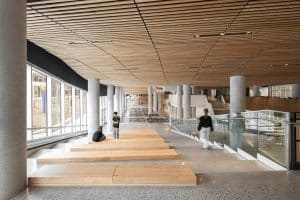
- École secondaire de la Croisée (LEED Gold)
- 38% reduction in energy consumption, driven notably by triple glazing and geothermal systems
- 29% reduction in water consumption
- 43% of regularly occupied spaces have access to natural light, and 78% of those same spaces have quality views

Beyond the numbers, the most structurally significant impact is often organizational: LEED forces alignment among stakeholders around a shared performance objective and standardizes methodologies. For both schools, the costs directly attributable to LEED certification (certification fees, professional fees, and site management for LEED) represented less than 0.2% of total construction costs, far below the commonly held assumptions about the significant expense of such a certification.
An Often Underestimated Lever: Human Performance
One angle that remains insufficiently integrated into value analysis is the impact on occupants.
In environments such as schools, where the quality of spaces directly influences users, the benefits are far from marginal:
- improved health and attendance
- improved concentration and academic performance
- enhanced comfort (natural light, thermal quality, acoustics)
- staff satisfaction and productivity
These factors are less frequently incorporated into traditional financial models, and have not been quantified here.
However, recent scientific literature provides clear indications of their significance. Studies on high-performing and certified buildings show notably:
- +26.4% improvement in cognitive performance
- +6.4% improvement in sleep quality
- 30% reduction in symptoms related to the indoor environment
These findings, drawn from research such as Cognitive Function and Human Performance – Healthy Buildings and the COGfx Study, suggest that the impact of high-performing buildings extends well beyond energy indicators alone.
In other words, in certain contexts, particularly institutional ones, a significant share of the value created lies with the occupants, not solely with the building itself. As a result, a criterion as important as academic achievement may be linked to the quality of learning environments, several parameters of which can be controlled through a certification such as LEED or WELL.
Why Some Stakeholders Are Moving Away Today
Decisions to abandon or forgo certification are rarely driven by a rejection of environmental value. They are instead motivated by: integration that occurs too late in the project, a perception of administrative complexity, or a lack of alignment among teams during the design phase. In these cases, LEED is experienced as a constraint. But this reflects primarily a problem of implementation, not of relevance.
A Frequently Underestimated Key Factor: The Timing of Integration
LEED does not deliver the same impact depending on when it is integrated.
- Late in the project: constraints, adjustments, perceived complexity
- From the design phase onward: natural optimization, low marginal costs, value maximized over the lifecycle
It is often these constraints, more than the certification itself, that shape the perception of “cost” versus “value.”
Reframing the Debate: LEED as a Strategic Lever
The LEED rating system remains, above all, a reference framework rather than an end in itself. Its relevance does not rest solely on meeting compliance criteria, but on its capacity to structure a coherent, performance-driven design process. It is then up to project teams to bring their creativity and expertise to bear in order to go beyond minimum requirements and maximize project value. To do so effectively, measurable objectives and a shared language remain essential.
In complex projects, the choice to pursue a certification such as LEED plays a role that extends well beyond the certification itself:
- it structures decision-making from procurement through occupancy
- it standardizes multiple performance criteria
- it reduces the risk of deviations from project objectives
- it improves the predictability of outcomes
- it strengthens the credibility of assets in the market
In this context, LEED acts more as a governance and quality assurance mechanism. It enables alignment across the entire value chain around a shared objective: reducing lifecycle impacts by integrating, from the design and construction phases onward, the operational realities that will influence long-term performance.
The Real Question Is Not About Cost
The debate is therefore not really about whether LEED costs too much. The real question is: Can complex real estate projects still be managed without a structured framework for measurable performance?
In a market where energy, environmental, and financial requirements are tightening simultaneously, that question is becoming increasingly difficult to justify. And in many cases, ignoring the impacts on operating costs and human performance means underestimating an essential share of the value.
If you are currently evaluating the relevance of LEED for a project, an early-stage analysis can often transform the perception of “cost” into a lever for value.