- June 8, 2026
The transition toward lower-carbon buildings is already well underway in the construction sector. It is driven by several complementary levers: improved energy performance, system innovation, project optimization, and the evolution of materials.
Within this momentum, one dimension is taking on growing importance: embodied carbon, meaning the emissions associated with materials and their installation.
The Construction Bas Carbone avec le Bois (CBCB) initiative, of which we are a signatory, is part of this collective effort by supporting better consideration of embodied carbon from the earliest design stages.
Better Understanding the Carbon of Buildings
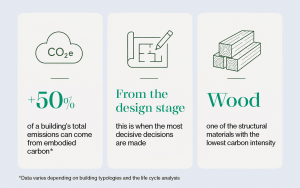
Generated during the production, transport, and assembly of materials, embodied carbon represents a significant share of a building’s overall footprint. It is therefore essential to account for it, in addition to the operational carbon generated over the years, in order to read the complete life cycle of projects.
The challenge today is to better integrate this dimension into design processes, on the same footing as other performance parameters.
Comparing Solutions to Better Reduce the Embodied Carbon of Projects
The evolution of design practices is leading to the consideration of more parameters from the earliest phases of a project. Carbon thus becomes an additional criterion in comparing scenarios, alongside functional, technical, and economic considerations. This approach allows for a better assessment of the impacts associated with the choice of systems and materials, and guides decisions toward a more complete vision.
Among the promising solutions for reducing embodied carbon, several families of materials and systems can be mobilized, notably wood, biosourced materials (such as straw or hemp), recycled or reused materials, as well as certain optimized mineral solutions (low-carbon concrete, reduced-clinker formulations, etc.). The optimization of construction systems and the reuse of existing components are also important levers.
Among these approaches, wood presents strong potential, notably thanks to its carbon storage capacity and its possible use as a substitute for more emission-intensive materials. To optimize its contribution, its integration should be assessed according to the context, the technical constraints, and the performance objectives of the project.
A Collective Approach
The transition toward lower-carbon buildings rests on collective momentum. It involves designers, engineers, manufacturers, and researchers, as well as sector organizations, who together contribute to advancing practices and knowledge.
In this context, the CBCB initiative plays a structuring role by bringing stakeholders together around embodied carbon and the contribution of wood to the sector’s decarbonization. It promotes knowledge sharing and the more systematic integration of carbon from the earliest design phases.